Padel court booking system: a practical guide
How to take padel court booking off the phone and out of chat threads: hours, prices, cancellation rules, coaching packs and one till for the whole club.
A padel club’s revenue is measured in hours. Every empty evening slot is money you’ll never get back, and selling the same hour to two groups costs you money and reputation at once. The problem is rarely the courts. It’s how bookings are taken: phone calls, WhatsApp threads, notes on the reception phone.
This guide covers practical ways to bring order to court booking and what to look for when choosing a padel court booking system.
Why phone booking hits a wall
Padel demand piles into a few hours: weekday evenings from 18:00 to 23:00 and weekend mornings. In those hours reception is answering calls, reading messages and taking payments all at once. The result is familiar:
- two people are told the same court is “free”;
- a player gives up waiting for a reply and books at another club;
- a message sent at 23:00 is answered in the morning, after the slot has passed;
- by month-end nobody can say exactly who paid what.
The fix is simple: let players see free time and book it themselves. Reception then deals only with the exceptions.
Set up courts and services properly
Before you move to software, make a few decisions on paper:
- Your list of courts. A name for each (“Court 1”, “Court 2 — outdoor”) and its opening hours. If the outdoor court closes in winter, put that in the schedule in advance.
- Game lengths. 60- and 90-minute games should be separate services, each with its own price.
- Peak and off-peak prices. Evenings and weekends cost more, daytime less — handle this with a separate service such as “Court, 90 minutes — evening”.
- Coaching. Private lesson, lesson for two, 10-lesson pack — each one separately.
When prices are clear, players don’t ask questions. They just book.
Without a cancellation rule, courts sit empty
The biggest loss in padel is the last-minute cancellation: one of four players drops out and the whole group cancels. You can’t prevent it entirely, but you can reduce it:
- Set a cancellation cut-off — say, 6 hours before the game. After that, players can’t cancel from the link themselves and have to message you.
- Set a minimum notice period — a booking for 15 minutes from now leaves no time to get the court ready.
- Send reminders. A daytime reminder about an evening game deals with forgetfulness and gives players the chance to cancel in time, so someone else can take the slot.
More on this: how to reduce no-shows.
Packs instead of memberships
Many clubs think about a monthly membership for regulars. In practice a time-limited pack is easier to manage: “8 games within 30 days” or “10 lessons with a coach”. The player pays up front and you can plan revenue. The one condition: the balance has to be counted accurately and the player has to be able to see it, or you’ll hear “how many have I got left?” every visit.
Courts, rackets, balls and the café — one till
A club’s income isn’t just court fees: racket hire, balls, water, coffee. If these live in a separate notebook or a separate till, you can’t see the day’s real takings. Everything should go through one till, and café products should come off stock as they’re sold, so you know something is running out before the shelf is empty. More on that: how to track inventory.
What to check in a demo
- Is each court shown separately in the calendar, and is it impossible to sell the same hour twice?
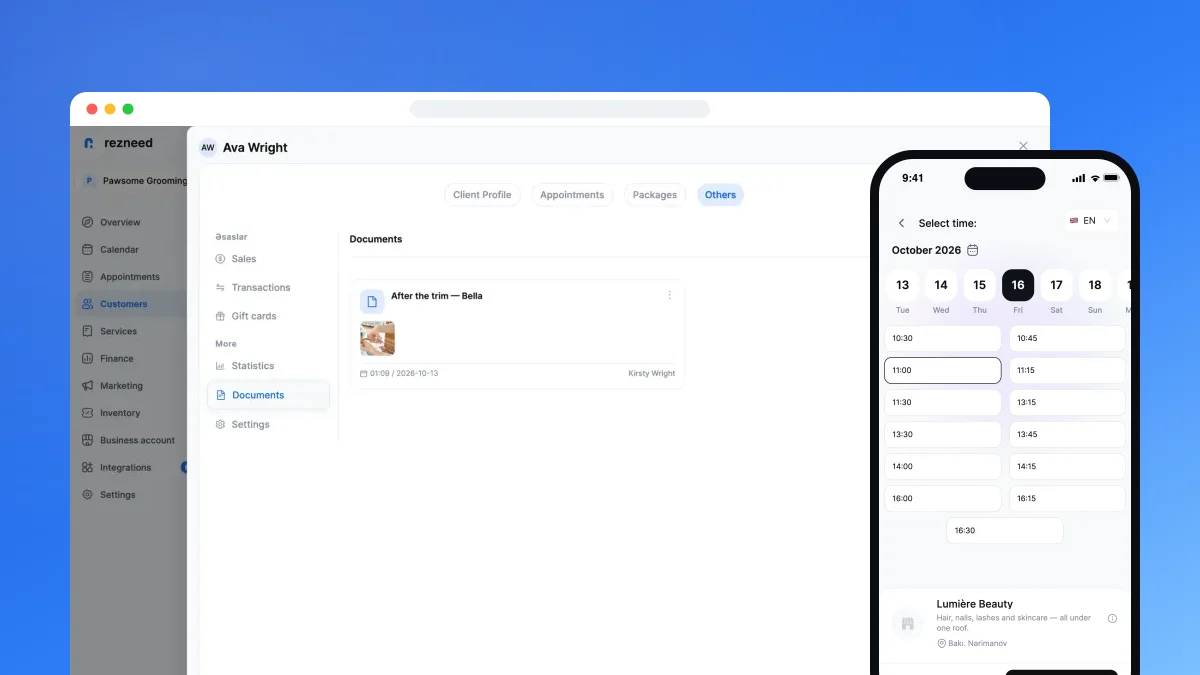
- Can players book from a link, with no password and no app?
- Can you set up 60- and 90-minute games and peak and off-peak prices separately?
- Can you set a cancellation cut-off and a minimum notice period?
- Do confirmations and reminders go out on WhatsApp from the club’s own number?
- Can players see what’s left on their coaching pack?
- Is each coach’s share worked out automatically per lesson?
- Are café sales and stock in the same till?
Rezneed for padel clubs
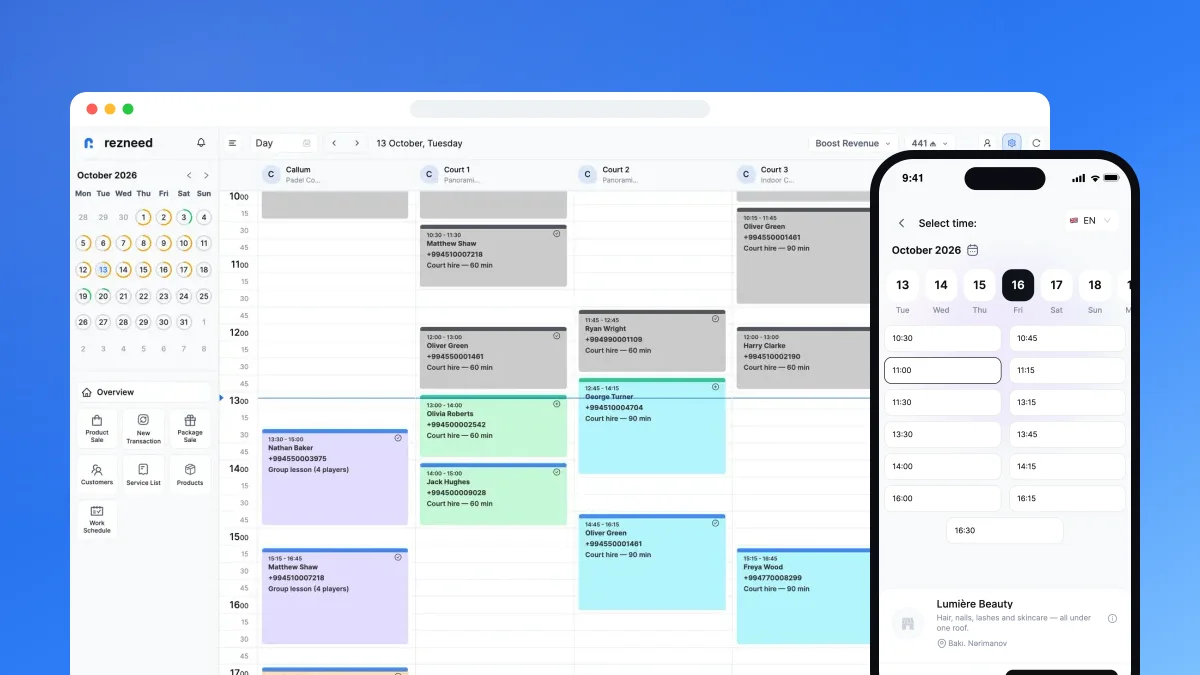
In Rezneed each court is its own calendar column: the court is created in the system as a staff member with its own opening hours. Players choose the court and time on the booking link — no password, no app — and you see every court’s day on one screen. The booking page never offers an hour that’s already taken. The link can go in your Instagram bio, on WhatsApp and on Google Maps, and the page opens in 6 languages.
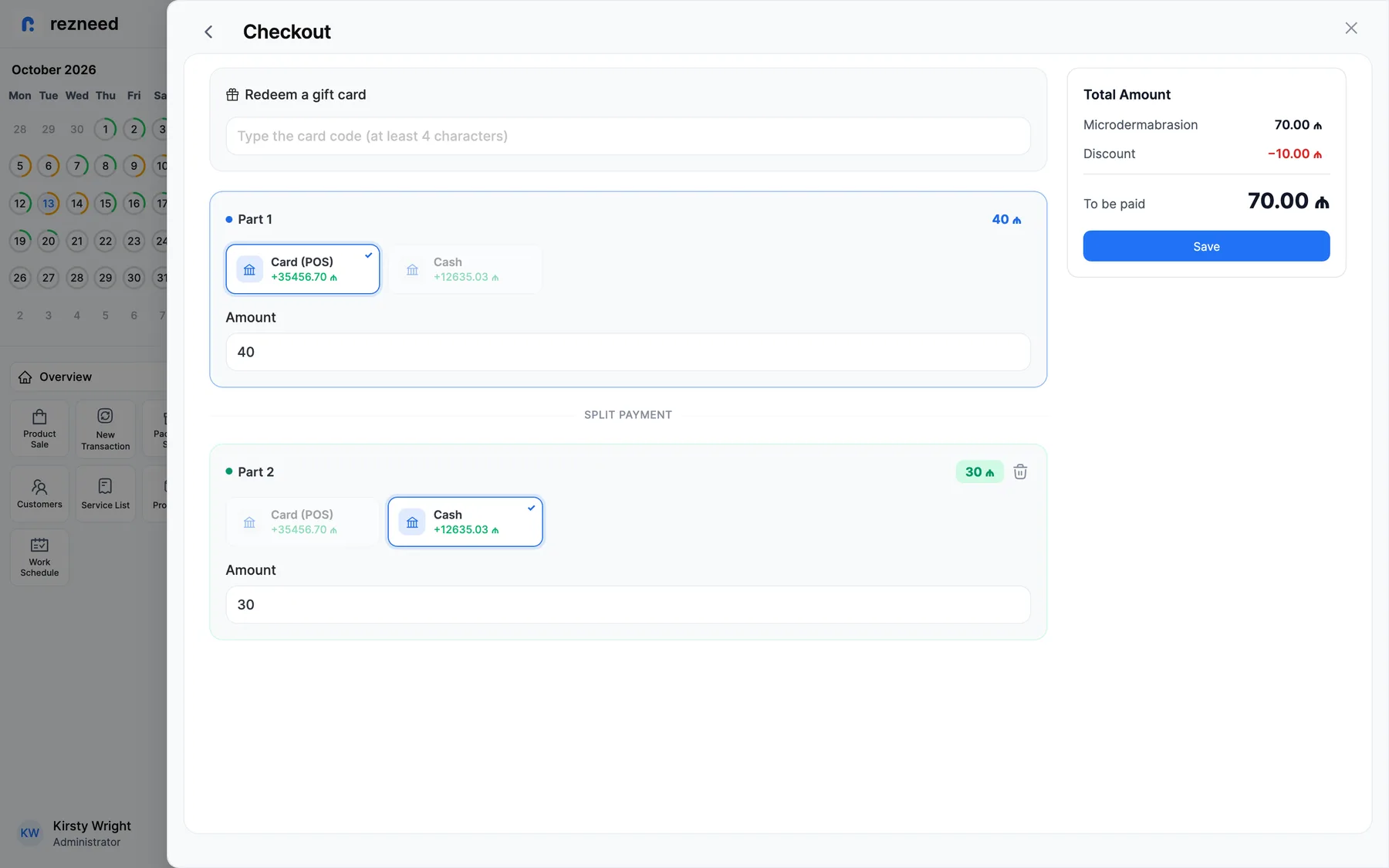
60- and 90-minute games and evening and weekend prices are set up as separate services. Each court gets a minimum notice period, and you can set a cut-off after which players can no longer cancel from the link. Automatic confirmations and reminders go out from the club’s own WhatsApp number and don’t use your message balance.
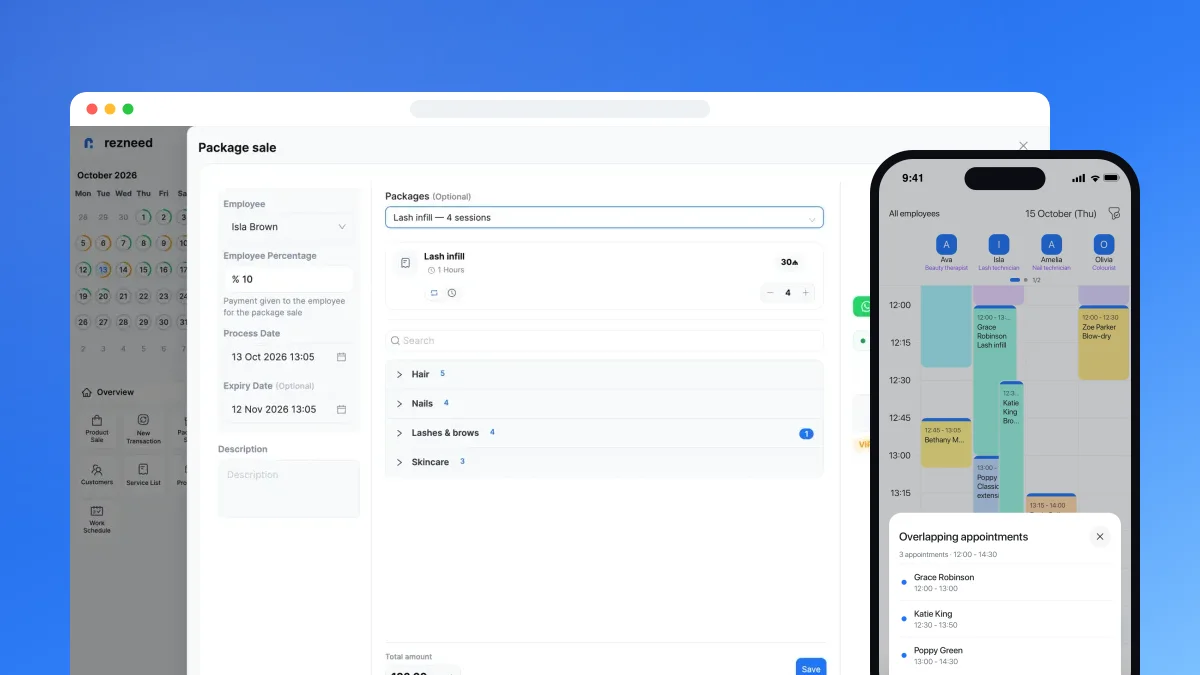
Coaching is sold as packages: each lesson comes off automatically and players see the balance in the client portal. Coaches earn a percentage or a fixed amount per lesson. Courts, racket hire, balls and drinks go through one till, and café products come off stock automatically.
Limits worth knowing up front:
- No unlimited monthly memberships — sell time-limited packs instead, such as 8 games within 30 days.
- A booking sits in one column. There’s no way to book a court and a coach together as a pair, so for a coached lesson you block the time in the other column by hand.
- No deposits. Players pay at the till in cash or by card; online card payment via Epoint is coming soon.
- Courts count as staff in your plan’s limit. Basic (49 ₼ a month) covers up to 3 columns and Premium (99 ₼) up to 12; Business (from 99 ₼) has no limit, at +6 ₼ a month for each column above 12. Count courts and coaches together. Details: pricing.
Everything Rezneed offers for padel: Rezneed for padel clubs.
Try it with your own courts and players: start Rezneed free for 45 days, no card required.